Written Commentary
by market analysts Stephen Platt and Mike McElroy
Price Overview
Crude oil failed to follow through on strong early gains traced to an attack by Iranian militants in Jordan that killed 3 US military personnel. The potential for US involvement to expand in retaliation for the attack initially helped inject risk premium into values, but that quickly dissipated as the March settled 1.23 lower at 76.78. The turnaround was traced to further questions over the Chinese economy and weakness in their property sector following a Hong Kong court ordered liquidation of property giant China Evergrande Group. The developer had more than $300 billion in total liabilities, and their failure to offer a concrete restructuring plan precipitated the move. The adverse impact of the ruling on the Chinese economy will be assessed against a backdrop of the weakest property market in nine years, poor export volumes, limited wage growth and a weak stock market. With China a key to growth in global oil demand, a reassessment of the supply-demand balance for 2024 and beyond is necessary. Concerns were exacerbated by reports from European policymakers that they remain at an impasse regarding when interest rates should be cut, while the US Federal Reserve Board meeting beginning tomorrow will be watched closely.
Today’s reversal to the downside is balancing out the tension in the Middle East which has been the underlying supportive factor. Concern has developed over the dramatic decline in US crude inventories, which should begin to ease as domestic production comes back online. Today’s retracement in the backwardation of the nearby to the back months in crude reflected production recovery following recent weather-related problems. With warmer temperatures in the forecast, demand for heating oil should ease. OPEC is a wild card with spare capacity at 4.5 mb/d. This has helped soften the impact of possible disruptions due to geopolitical factors. The drone strikes against Russian oil facilities still need to be considered as a threat to supplies, which might be offset by the possibility that voluntary cuts will be eased in April, making a consolidation in the 70-76 range possible once again.
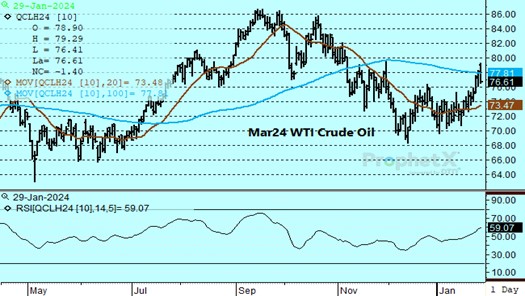
The DOE report on Wednesday is expected to show crude inventories falling .9 mb, distillate down .5 and gasoline up 1.7. Refinery utilization is estimated to have gained 2.3 to 87.8 percent.
Natural Gas
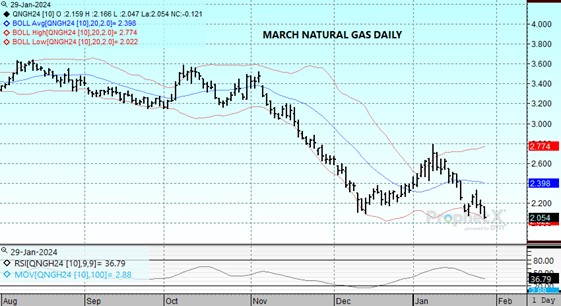
The expiration of the February contract with a loss of over 22 cents helped pull down the deferred months, as the March achieved a new intraday low before settling down 12.1 cents at 2.054. Further recovery in production levels over the weekend to near 107 bcf/d coupled with repairs on one of Freeport’s LNG trains continued to weigh on values. Even with gains in Heating Degree Day expectations coming out of the weekend, the changes were not enough to garner any buying interest as the overall forecast remained tepid. The poor close and new lows point to a likely near term test of 2 dollars, with the 1.94 area the next level of support from the weekly charts. With winter winding down, a sustained rally will be difficult to achieve. A settlement above resistance at 2.25 would be necessary to ignite any technical interest in being long.
Futures and options trading involve significant risk of loss and may not be suitable for everyone. Therefore, carefully consider whether such trading is suitable for you in light of your financial condition. The information and comments contained herein is provided by ADMIS and in no way should be construed to be information provided by ADM. The author of this report did not have a financial interest in any of the contracts discussed in this report at the time the report was prepared. The information provided is designed to assist in your analysis and evaluation of the futures and options markets. However, any decisions you may make to buy, sell or hold a futures or options position on such research are entirely your own and not in any way deemed to be endorsed by or attributed to ADMIS. Copyright ADM Investor Services, Inc.
