Written Commentary
by market analysts Stephen Platt and Mike McElroy
Price Overview
The petroleum complex failed to follow-through on early strength that saw the February reach a high of 75.37, settling with a 28-cent gain at 74.22. The late weakness was linked to reports of a possible pause of fighting in Gaza and to the DOE report which showed a build in crude inventories. Although concerns remained over attacks in the Red Sea by Houthi rebels targeting all ships heading toward Israel, the possibility of a pause in the war encouraged profit taking. In addition, the establishment of a joint task force by the US and other western powers to shoot down Houthi missiles and drones targeting shipping was in the background as a limiting factor. How effective the task force will be is up for debate given that the considerable number of vessels traveling the Red Sea precludes the possibility that they would be able to accompany ships but would merely position vessels in areas where they might have the greatest security benefit. The Suez Canal and Red Sea handle near 2.5 mb/d of crude. Whether the problems there expand to involve Iran, who is a major backer of the Houthis, remains to be seen.
The DOE report weighed on values. Commercial crude inventories rose 2.9 mb, with .6 mb added to the SPR. Cushing stocks continues to build, gaining 1.7 to 32.5 mb. Gasoline inventories rose 2.7 mb and distillates were up by 1.5. Refinery utilization rose 2.2 percent to 92.4. Total product supplied remained buoyant at 20.8 mb/d with gasoline at 8.8 mb and distillate at 3.6. Net exports of crude and products totaled 1.8 mb which was unchanged from last week.
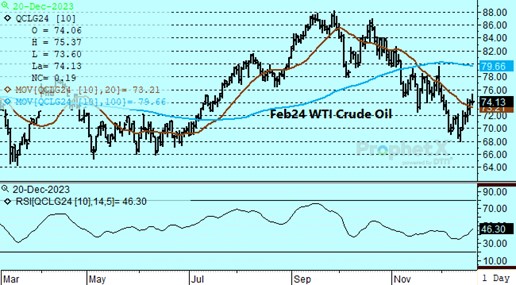
The test of the 75.20 level today, which is a 38 percent retracement of the recent break, marked a near term top for the market. Nevertheless, the tension in the Middle East should provide support toward the 20-day moving average at 73.25 basis February, and any uptick in the conflict could provide the basis for values to move back toward the 78.00-79.00 range. Consumption concerns, particularly in China and Japan, remain in the background along with OPEC+ compliance with voluntary production cuts.
Natural Gas
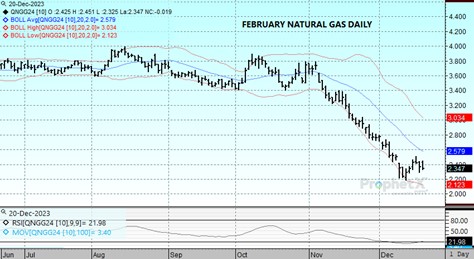
After experiencing weakness yesterday, the natural gas traded sideways today before settling with a 1.9 cent loss at 2.347 basis February. Trade continues to focus on early January forecasts, with minor revisions in both directions guiding price action over the last few sessions. The market has been willing to rally with signs of a mere normalization in demand, and the next few days may determine if the recent bounce can be maintained or if the lows are revisited. Tomorrow’s weekly storage report is expected to show a draw near 80 bcf, which would be well below the 5-year average for this time of year at 107. The settlement back below the 9-day moving average the last two days is a near term negative, with the next level of support near 2.28 and then at 2.21. With year end creeping up, any help from cooler temperatures could trigger additional short covering and exaggerate a bounce, with the 2.51 and 2.60 levels as resistance on the way up.
Futures and options trading involve significant risk of loss and may not be suitable for everyone. Therefore, carefully consider whether such trading is suitable for you in light of your financial condition. The information and comments contained herein is provided by ADMIS and in no way should be construed to be information provided by ADM. The author of this report did not have a financial interest in any of the contracts discussed in this report at the time the report was prepared. The information provided is designed to assist in your analysis and evaluation of the futures and options markets. However, any decisions you may make to buy, sell or hold a futures or options position on such research are entirely your own and not in any way deemed to be endorsed by or attributed to ADMIS. Copyright ADM Investor Services, Inc.
